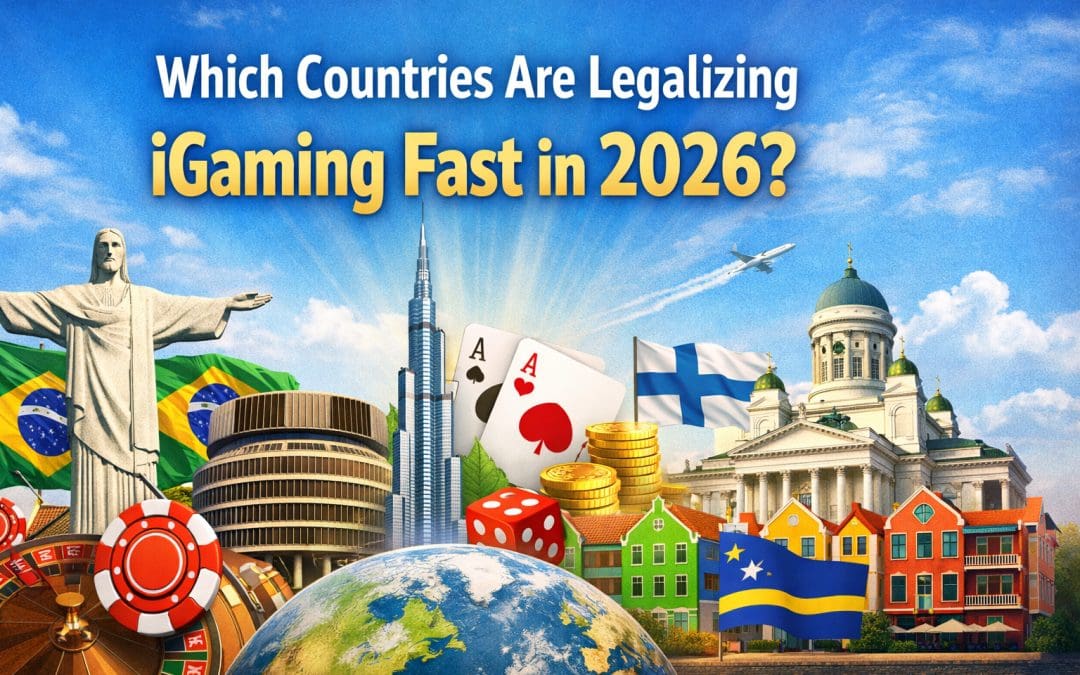
As we move forward in the online gambling space, it becomes easier to distinguish between countries that are “opening” their doors to the gambling industry for the first time, versus those that are simply cleaning up an existing gray market, and finally, those that have made no movement towards legality regardless of the rhetoric surrounding conferences. In 2026, it will matter which type of country is moving the quickest. Brazil is taking a chaotic gray market and converting it into a federal licensing system. New zealand is creating a comprehensive online casino framework from scratch. Finland is taking down part of a monopoly model and placing betting and online casinos into a future competitive license regime. The united arab emirates has gone from theoretical possibility to an actual federal commercial gaming authority with internet gaming included in scope. Curaçao is not a “new market” for players, however, it is undergoing one of the largest license resets in the offshore world. (serviços e informações do Brasil)
Additionally, there are many names that are constantly grouped together in the media and by other sources that do not belong in the same group. The Philippines is not “legalizing” igaming in 2026, but instead is increasing the regulations of domestic online gaming after banning offshore gaming. India is still a patchwork story with national online gaming regulations and ongoing legal issues, not a clear nationwide online casino opening. Indonesia and Bangladesh are still on the enforcement side of the ledger. Kazakhstan is establishing controlled gambling zones, but that is not equivalent to opening a mainstream regulated online casino market.
Therefore, if your question is “where is igaming legalization rapidly advancing in 2026?”, the short list is smaller than the hype indicates.
Brazil is the loudest real breakthrough in 2026
Brazil should get number one status due to its ability to meet both scale and timing. Brazil’s legal base was established by law number 14,790 near the end of 2023; however, it was not until the federal regime began operating in January 2025 and only SPA-authorized operators could lawfully operate that a practical shift occurred. By march 24th, 2026 Brazil’s Ministry of Finance continued to update its official list of nationally authorized fixed odds betting operators; thus indicating two aspects simultaneously: the market is open, and the regulatory build-out continues to evolve. The SPA now operates as the center of authorization, supervision, sanctions, and rule-making.
Brazil feels more like a compliance treadmill for operators due to its history of having significant demand for online gambling and subsequently attempting to formalize the entire industry at speed. When a country establishes a mass-consumer appetite for an activity such as online gambling and attempts to formalize the entire industry quickly, typically what follows is a compliance treadmill for operators. The regulator is doing more than handing out approvals; it is developing the infrastructure: monitoring, enforcement, barred bettor tools, payment oversight, AML compliance and enhanced market conduct standards. Industry attorneys and consultants may debate the effective tax burden on the basis of political contention; however, there is no disagreement regarding Brazil’s primary contribution to the 2026 igaming legalization conversation: Brazil is not a low-friction licensing play. It is a large regulated market with real entry costs, real scrutiny and a regulator that continues to add layers.
This is why Brazil is such a critical piece to the igaming legalization 2026 discussion. Brazil is not simply permitting online betting; it is compelling the industry to choose: licensed and supervised or illegal and increasingly isolated from payment processing, advertising and sponsorship. This changes the math overnight for affiliates, platform providers and b2b suppliers. The “just localize and test traffic” business approach will not survive long in an environment moving so quickly toward formal regulation. (serviços e informações do Brasil)
New zealand is developing true online casino framework from scratch
New zealand represents perhaps the clearest example of an entity that is legally permitting online gambling rather than merely tweaking existing rules. According to The Department of Internal Affairs, online casino gambling remains unregulated, there are no regulated sites that can be identified and legislation has been under development with passage expected early 2026. Additionally, the department states that the future model provides for up to fifteen licensed operators and includes harm minimization, consumer protection requirements, restrictions on advertising and a public register of licensed operators.
This represents a meaningful shift as new zealand previously operated in an awkward familiarity – locals were able access offshore websites whereby domestic online casinos were illegitimate and consumers had limited recourse if something went wrong. The new model is attempting to channel this demand into systems that the state can effectively supervise. In fact, The Department of Internal Affairs provider guidance goes further in detailing the implementation path. Upon passage of the legislation, the act will commence on may first, 2026 prohibiting all unlicensed online casino advertising with increased penalties. Existing operators may continue their current operations until december first, 2026 and the licensing process is anticipated to follow after that.
This type of market opening is exactly why people in the sector love to discuss it – the shape is familiar. Limited numbers of licenses. Strong player protections. A fairly straightforward public policy case for channelization. Clear tax and duty architecture. In its own FAQ regarding licensed operators, new zealand anticipates those operators pay GST, online betting duty, problem gaming levy and corporate taxes where applicable. This is not casual experimentation; this is a full-bore effort to create a regulated i-gaming market where none existed prior in domestic form.
If i had to choose one jurisdiction that i believe people will underestimate due to its smaller size compared to Brazil would be new zealand. Although small regulated markets can provide considerable economic benefit to participants due to them serving as models for other jurisdictions’ regulatory language surrounding issues such as public registers, harm controls, technical standards and advertising restrictions often find their way elsewhere later down the road.
Finland is not yet open; however, the legal turn is clearly discernible
Finland is perhaps the most interesting story in Europe because it is transitioning from monopoly logic to a licensing model for specific online verticals. According to The Ministry of the Interior, the new Gambling Act will provide competition for betting games, online slot and casino games and money bingo through online channels. Additionally, the ministry indicates that gambling companies will be allowed to apply for licenses beginning on march first, 2026 while services approved through these licenses may begin operating on july first, 2027; thus Veikkaus maintains its monopoly status until the end of June 2027. (Sisäministeriö)
Because of timing alone, therefore Finland does not represent a fully opened 2026 market similar to Brazil. However, Finland belongs in any discussion regarding countries that are legalizing online gambling in 2026 because the country is currently establishing legal machinery for both types of licenses. Fees are already being added to the decree framework and the primary policy objective is clearly stated as improving channelization rates for more gaming activities to occur within nationally regulated and supervised systems rather than with offshore-based operators. (Sisäministeriö)
In practical terms this represents classic european policy thinking in 2026 – less concern about whether or not people gamble online than who supervises them how they do it and how the state can reduce harm without pretending off-shore supply does not exist. Finland finally has moved past old fictions surrounding monopoly protection being sufficient enough in digital markets. (Valtioneuvosto)
The UAE has become impossible to ignore
Approximately two years ago serious individuals would have still provided caveats before engaging in discussions regarding the UAE’s gaming landscape. Today that conversation has become much more concrete. The general commercial gaming regulatory authority states that it has exclusive jurisdiction over regulating, authorizing and supervising all commercial gaming facilities and activities in the UAE including internet gaming/sports wagering/lottery/and land-based gaming facilities. (GCGRA.gov.ae)
The UAE is not suddenly an open online casino gold rush; nevertheless the creation of a sole competent authority for regulating commercial gaming activities at the federal level represents a huge change by itself. In regulatory terms once a country creates a sole competent authority publishes a licensing path names internet gaming as an activity it regulates that jurisdiction has crossed from speculation to jurisdictional fact. (GCGRA.gov.ae)
There is a trade-off here for operators looking at the UAE – brand value regional significance & long-term upside. They will also see a selective supervisor political sensitivity & tighter controls on suitability integrity & conduct. This is likely going to feel like the old off-shore expansion business plan – not rapid legalization – just very selective legalization. (GCGRA.gov.ae)
Curaçao is creating a new kind of offshore reality
Curaçao exists in an odd category since it has been an igaming name for decades; however curaçao is undergoing one of the largest legal changes in the sector between 2025 – 2026. Curaçao gaming authority states that under the recently implemented National Ordinance on Games of Chance known as LOK it is now responsible for regulating the online gaming industry and providing oversight of AML & counter terrorism financing compliance. This represents a significant break from the old master-license & sub-licence era which was responsible for giving curaçao its reputation for speed flexibility & thin oversight. (cga.cw)
Labeling this “legalization” depends on perspective – for players curaçao-licensed operators were everywhere; therefore for license holders & vendors 2026 represents genuine legal reset – direct licensing enhanced responsible gaming rules & formalized AML/CFT posture increase value of curaçao license. Curaçao license is no longer simply fast off-shore answer for companies not ready for malta gaming authority standard; instead becoming structured compliance jurisdiction in its own right. (cga.cw)
This matters because rarely do emerging igaming jurisdictions develop independently – many new market entrants still need base jurisdiction while pursuing approvals from various governments worldwide. Curaçao’s rebuild is part of larger global narrative in 2026 – more regulators want cleaner ownership records clearer KYC stricter anti-money laundering compliance & stronger player-protection laws. Even off-shore hubs are being pushed in direction.
Where people continue to name places that aren’t actually opening up
There’s certainly activity at the federal level concerning online gaming. And there is an official set of rules governing self-regulatory bodies, permissible forms of online real money gaming, how to handle grievances, and user protections related to spending or time limits. However, that isn’t exactly a nationwide online casino framework. India still has the normal divisions between skill gaming, chance based gambling, and state-specific differences. Anyone pitching India as a single simple iGaming license country in 2026 is over-selling it.
Indonesia isn’t opening. The Government continues to block gambling content and treats online gambling as illegal. Millions of gambling-related posts have been removed; fresh enforcement actions will occur throughout 2026. Bangladesh is also moving the other direction with a zero tolerance policy towards promoting online gambling and cyber law penalties. Kazakhstan is taking a more subtle approach and expanding gambling zones for foreign visitors; however, this is primarily focused on territorial tourism based gambling versus a broader online betting legal country story. (AGB)
A lot of market commentary gets confused here. Any form of regulatory movement doesn’t constitute legalization. A country could create additional zones, restrict current regulations, ban one segment of gaming while creating a formalized version of another. These are completely different conclusions for operators, suppliers and players.
While Latin America has continued to gain momentum, not all markets are “new” and therefore open.
Colombia should receive credit, but not solely for it being one of the “new” iGaming markets in 2026. Colombia has been a regulated online market for years via Coljuegos, which includes self exclusion tools and established formal consumer protections. Therefore, Colombia represents a key benchmark for measuring Latin American momentum; however, it is not a fresh legalization story of the year. (coljuegos.gov.co)
Peru is another example of a market that has entered the regulated space and is now being increased with tax and AML rules vs. being newly legalized from scratch. Likewise, Ontario is a well-established regulated benchmark; not a 2026 entrant. iGaming Ontario’s own reporting continues to serve as a reminder of what a functional regulated market looks like – ongoing activity from licensed operators, consistent public performance metrics, and an established separation of responsibilities for regulating the market versus managing commercial aspects. Malta acts as the veteran licensing jurisdiction upon which many others compare themselves. For Italy, it is in a licensing cycle with regards to tender/concession reform, not initial wave legalization. (EY)
Making this distinction provides insight into where the true edge exists in 2026. While money flows to regulated iGaming markets; money flows to those countries transitioning from either gray area/monopoly era structures to fully constructed online licensing frameworks.
What does the 2026 trend really look like?
The overarching theme this year is not complete liberalization across jurisdictions. Rather, it is selective legalization with more comprehensive rulebooks. Regulatory bodies are no longer merely stating yes to online betting; instead they require:
- local companies,
- approved payment rails,
- anti-money laundering compliance,
- public registries,
- self-exclusion mechanisms,
- advertising restrictions, and
- credible enforcement.
Brazil, New Zealand, Finland, the UAE, and Curaçao represent examples of these various types of approaches.
Therefore, the traditional off-shore first mentality is decreasingly relevant. Rapid iGaming legalization this year does not equate to a free-for-all. Most often it indicates the opposite. Countries progressing quickest are accomplishing so because they wish to bring their online revenue streams into taxable systems that they can monitor and defend politically.
Player protection legislation becomes increasingly prescriptive. Taxation/GGR rates associated with gambling tax reforms become integral components of market design. Regulatory bodies are demanding greater levels of accountability with regards to affiliates, digital wallet payments, content providers and control over operational companies.
If I were compelled to simply put my hand down and say who are the countries moving forward most credibly and quickly regarding iGaming legalization in 2026? Those countries would be Brazil, New Zealand, Finland and the UAE. Curaçao would be considered an essential element due to its significant overhaul of its existing licensing jurisdiction structure. The Philippines will be undergoing reform rather than entering the space as an open market. Colombia, Ontario, Malta and Italy provide excellent examples of regulated markets; however, they are not the “just legalized” story du jour. India remains uncertain. Indonesia and Bangladesh are restrictive. Kazakhstan offers a niche product within designated areas/zones. (Serviços e Informações do Brasil).
I realize this description may be somewhat less exciting than “the global boom,” however it is much closer to reality.